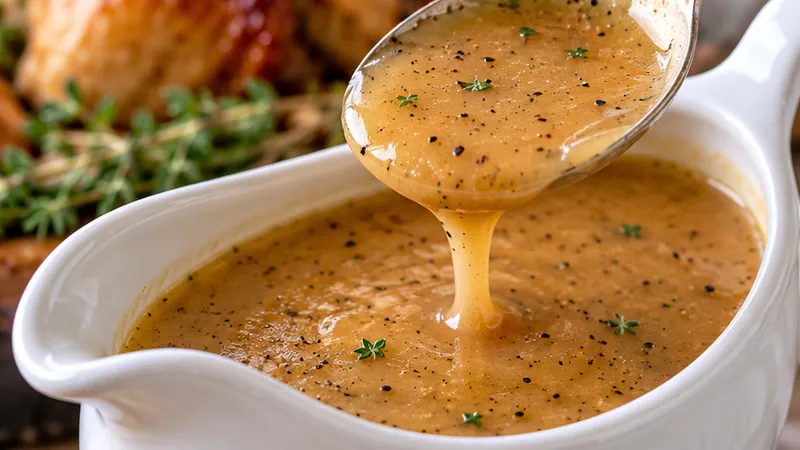
There is something about a gravy boat full of glossy, golden brown turkey gravy that makes the whole holiday table feel complete. This one is rich and velvety, with deep roasted flavor from the pan drippings, a gentle herby aroma from fresh thyme and sage, and a smooth texture that pools beautifully over mashed potatoes without ever turning gluey.
Make it while your turkey rests, which is exactly the window you need. The bird stays juicy under its foil tent, and in that time you can strain the drippings, cook a quick roux, and whisk everything into a sauce that tastes like it simmered all afternoon. It works just as well for a roasted turkey breast on a Sunday or a smaller Friendsgiving spread.
 Save
If gravy has ever made you nervous, you are in good company. So many of us have stood over a lumpy pan on Thanksgiving with guests hovering nearby. This method is forgiving and steady: warm broth, a slow pour, and constant whisking. Once you make it this way, you will never reach for a packet again.
Easy Homemade Turkey Gravy
Ingredients
Roux
Gravy
Instructions
- Separate the drippings
Once the turkey is out of the roasting pan and resting, pour the drippings into a fat separator or a heatproof measuring cup. Let them sit for about 5 minutes so the fat rises to the top. Spoon off 1/4 cup of the clear golden fat for the roux, then measure 1/2 cup of the darker juices underneath and set both aside.
- Warm the broth
Pour the 3 cups of broth into a small saucepan, add the thyme sprig, and set it over medium-low heat until it is steaming but not boiling. Warm broth blends into the roux far more smoothly than cold broth, which is one of the easiest ways to avoid lumps.
- Deglaze the roasting pan
Set the empty roasting pan over two burners on medium heat and ladle in 1/2 cup of the warm broth. Scrape the bottom firmly with a wooden spoon or flat spatula to loosen all the browned bits, about 1 minute. Pour this flavorful liquid into the cup with the reserved pan juices.
- Melt the fat
In a large saucepan or deep skillet over medium heat, add the 1/4 cup turkey fat and the butter. Heat until the butter melts completely and stops foaming, about 1 minute.
- Soften the shallot
Add the minced shallot to the melted fat and stir for about 2 minutes, until it turns soft and translucent and smells sweet. Keep the heat at medium so the shallot does not brown too quickly.
- Cook the roux
Sprinkle the flour evenly over the fat and whisk constantly for 2 to 3 minutes. The paste will bubble, loosen slightly, and turn the color of peanut butter with a toasty, nutty aroma. Cooking it this long removes any raw flour taste.
- Whisk in the liquids
Remove the thyme sprig from the broth. While whisking steadily, pour the pan juice mixture into the roux first, then add the remaining 2 1/2 cups of warm broth about 1/2 cup at a time, whisking until smooth after each addition. The gravy will look thick at first and then relax as more broth goes in.
- Simmer until thickened
Bring the gravy to a gentle simmer, stir in the chopped sage, and cook for 6 to 8 minutes, whisking often, until it coats the back of a spoon and a line drawn through it with your finger holds its shape. If it gets thicker than you like, whisk in a splash of hot water or broth.
- Season to taste
Stir in the Worcestershire sauce, kosher salt, and black pepper. Taste and adjust, keeping in mind that pan drippings can be salty depending on how the turkey was seasoned. For a richer, creamier finish, whisk in the heavy cream and let it heat through for 30 seconds.
- Strain and serve
For an ultra smooth gravy, pour it through a fine mesh strainer into a warmed gravy boat, pressing gently on the shallot pieces. If you prefer a more rustic texture, skip straining. Serve right away while it is hot and glossy.
Substitutions and variations
- If your turkey gave you less than 1/4 cup of fat, make up the difference with more butter so you still have 6 tablespoons of fat in total.
- For a gluten-free gravy, skip the flour roux and thicken the simmering broth with 2 tablespoons cornstarch whisked into 3 tablespoons cold water.
- Swap the fresh sage for 1/4 teaspoon dried rubbed sage, added with the broth so it has time to soften.
- Replace 1/2 cup of the broth with dry white wine for a brighter, slightly tangy gravy; let it bubble for an extra minute to cook off the alcohol.
Chloe's tips
- Whisk constantly when adding the broth, and add it gradually; a flat whisk reaches into the corners of the pan better than a balloon whisk.
- If lumps sneak in anyway, blend the gravy for a few seconds with an immersion blender or simply strain it.
- Taste before adding any salt, since brined or dry-rubbed turkeys produce very salty drippings.
- Keep the finished gravy warm over the lowest heat with a lid on, and whisk in a little broth just before serving if a skin forms.
How to store it
- Cool leftover gravy completely, then refrigerate it in an airtight container for up to 4 days.
- Freeze gravy in freezer bags or containers for up to 3 months, and thaw overnight in the refrigerator.
- Reheat gently in a saucepan over medium-low heat, whisking in 2 to 3 tablespoons of broth or water to loosen it as it warms.
- You can make the gravy up to 2 days ahead using roasted turkey wings for drippings, then rewarm it on Thanksgiving Day.
Serving suggestions
This turkey gravy belongs on just about everything on the holiday plate.
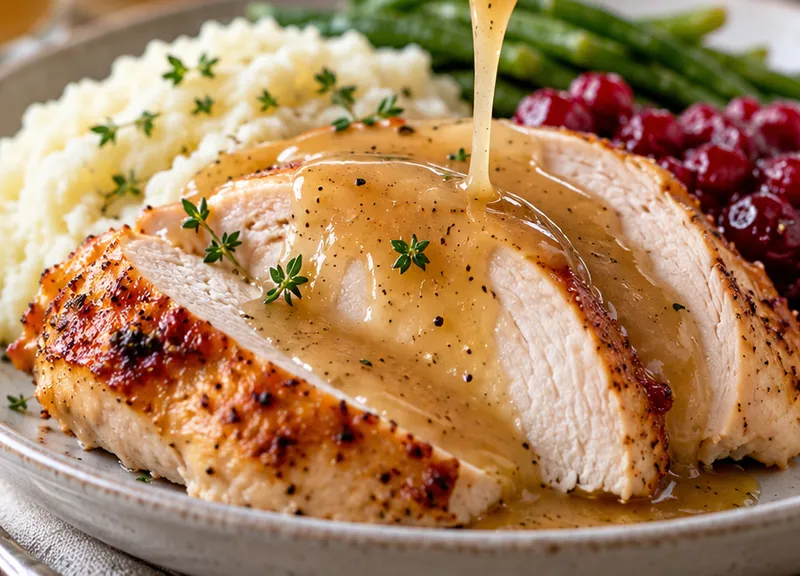
- Ladled generously over sliced roast turkey
- Poured into a well of creamy mashed potatoes
- Spooned over savory herb stuffing
- Drizzled on open-faced leftover turkey sandwiches
- With warm buttermilk biscuits for a cozy breakfast the next morning
Frequently asked questions
How do I fix gravy that is too thin?
Let it simmer a few minutes longer to reduce, or whisk 1 tablespoon cornstarch into 2 tablespoons cold water and stir it into the simmering gravy. It will thicken within a minute or two.
Can I make turkey gravy without drippings?
Yes. Use 6 tablespoons of butter in place of the turkey fat and butter, and replace the pan juices with an extra 1/2 cup of broth. Adding the Worcestershire sauce and herbs helps give it that roasted depth.
Why did my gravy turn out lumpy?
Lumps usually happen when cold liquid hits hot roux or when the liquid goes in too fast. Warm the broth first, pour slowly, and whisk the whole time. Straining fixes any lumps that still appear.
How much gravy should I make per person?
Plan on about 1/3 cup per guest, plus a little extra for second helpings and leftovers. This recipe makes about 3 1/2 cups, which serves 8 comfortably.
Let's get cooking!
With a little warm broth, a patient whisk, and the drippings you already have, homemade turkey gravy is easier than you ever imagined. Make it once and it will become the part of the meal everyone asks about. Pour it on generously, enjoy every savory spoonful, and have a happy, delicious holiday!